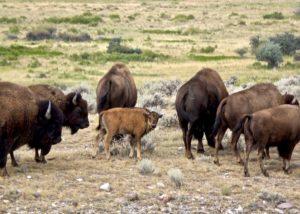
Custer State Park rangers manage 1400 bison to protect 71,000 acres of enclosed park land. Herd size is limited to provide a sustainable habitat. In the 1960s, Custer State Park became brucellosis free, which meant that the Park could start selling their excess buffalo to other refugees or ranches through auction. Since these grasslands can only support about 1000 buffalo through the winter, 400 hundred animals are now sold annually.
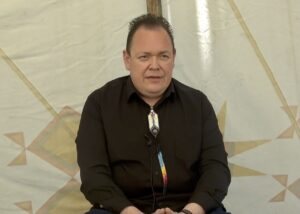
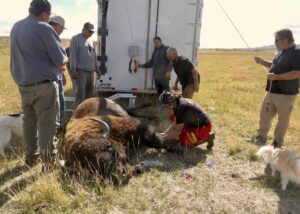
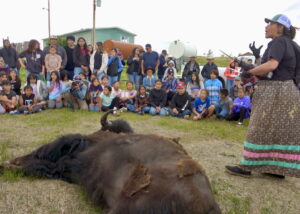
During this annual roundup, buffalo are gathered into corrals where they are tested, given shots and selected for the fall auction. This has become a well-attended public event. Parking begins before the sun even begins to shine in the morning sky. Lights from the cars can be seen arriving early to get good seats. Around nine a.m. the Governor rides in and gives his official blessing. Many families gather to witness and support this event, enjoying a meal of buffalo brisket together. Lydia Austin, Custer State Park Visitor Services Coordinator, shares the story and history of the park and its inhabitants with a wide range of visitors.
Lydia Austin says the buffalo are part of the park family and recognized as the species that helps the grasslands thrive. Being a part of the renewal of the North America Buffalo is a point of pride for all of Custer State Park employees.
Custer State Park is just one part of this buffalo restoration. The story of this herd begins with two white cattlemen, married to Indian women, working in the industry that ‘replaced’ the buffalo, who ended up helping ‘save’ the buffalo. And it all started with the capture of 5 buffalo calves in 1883.
In 1914 South Dakota bought 36 head of buffalo from the estate of Scotty Philip and placed them in the newly established Custer State Park. This herd is considered one of the five crucial ‘founding herds’ from which nearly all the 500,000 buffalo today are descended. Of these herds only the Yellowstone bison remained wild – from the few dozen that survived hidden away in the remote Pelican Valley.
The other herds were the result of ranchers who captured a few buffalo in the 1880’s as the species was being hunted into extinction. The harsh winters of that decade devastated cattle herds, but the wild bison survived the harshest storms. Most of these cattlemen were motivated by the idea of a cold-hardy livestock which they hoped to establish by cross breeding cattle and bison. But a couple of these ranchers were conservationists before their time. The origins of the Custer State Park herd are from two such men.
At the time of ‘Scotty’ Philip’s death in 1911 his herd, which numbered between 900-1000 buffalo, was the largest in the world. With no takers for the whole lot, they were dispersed to various parks, refugees and ranches. Custer State Park’s original 36 buffalo came from this herd.
Philip was a cattle rancher running over 20,000 head. His affinity towards buffalo was most likely due to the influence of his Lakota wife, Sally. He bought his first buffalo from the man who started this herd, Frederick Dupree, when Dupree passed away in 1898.
Dupree was born in 1818 in Quebec, Canada. By 1838 he had found his way to Fort Pierre where he worked in the buffalo pelt trade. By 1855 he was establishing himself in the next big thing – raising cattle. As Dupree’s herd grew, so did his family. He raised 10 children with his wife, Mary Ann Good Elk Woman, who came from a Central Lakota Sioux people known as the Miniconjou.
The Dupree’s prospered. Their main camp grew with small log houses built as each of their children married. The property was dotted with a dozen or more tipis housing Mary’s relatives. The 1887 marriage of their daughter Marcella to a ‘non-Indian’ who was related to the governor of the Illinois Territory was reported in a Pierre newspaper as a major social event of the year. Fred’s wedding gift to the newlyweds was 500 cattle and 50 ponies.
Dupree had lived through the demise of the buffalo and had actively participated in it. Perhaps realizing the buffaloes’ rapid path towards extinction, in 1883 Dupree and some of his sons went out on the prairie to capture some. They returned with five buffalo calves. These grew into the 80 head herd that Philip bought in 1898 and that became the origins of the Custer State Park herd.