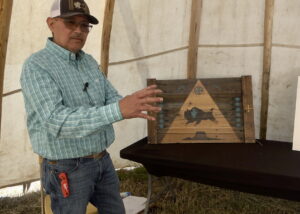
Buffalo trunks are popular teaching tools, illustrating the strong connections of buffalo to Plains tribes. This form of hands-on learning allows users to appreciate how intertwined these magnificent animals were with peoples’ daily lives. Northern Cheyenne historian and tribal member, Linwood Tall Bull (Ho’neh’eso or Young Wolf) explains the trunk’s contents which were created by his son, Randall James Tall Bull (H’aest’ohena’hane or Many Kills).
Tall Bull shares stories of Buffalo Jumps and their connection to the Little People. The Cheyenne respected these beings, cleaning up the kill sites after processing the buffalo at the foot of the jump. He tells of his grandmother harvesting the last buffalo on their lands, providing meat for the elderly that camped near their home. As he is telling these stories, Tall Bull is always being mindful, understanding that the spirits of his ancestors are listening.
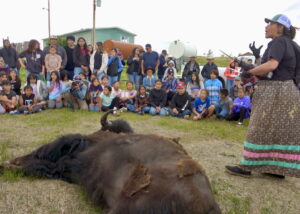
NMP board member Patti Baldes was born on the Big Pine Paiute Reservation in California and raised on the Wind River Reservation in Wyoming. An enrolled member of the Northern Arapaho, of Northern Paiute descent, Patti works with the Wind River Tribal Buffalo Tribal Initiative to reawaken buffalo memory in communities and K-12 schools. Here, she demonstrates how to make a children’s toy from a buffalo hoof.
Buffalo hooves had many different uses. They could, for example, be made into ladies’ buffalo hoof bags, or boiled down to provide the base for a protein rich soup, or to make a strong household glue.
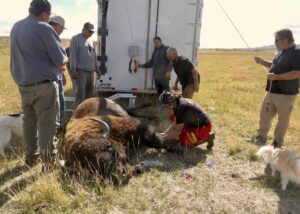
Darlene Johnston remembers the art of making dried buffalo meat as one of the many skills her parents taught her when growing up on the Wind River Reservation. To prevent fresh meat from spoiling during the hot summer months, it would be cut into thin strips, draped over a pole, then turned over throughout the day, exposing both sides to the air and hastening the drying process. Similar techniques are still used today.
Patti Baldes explains how parts of a buffalo were traditionally used. Everyday items included cups, bowls, and spoons. No part went to waste. Patti shares the ancient connection she has with buffalo, a bond that makes her feel part of something greater than herself. She believes that traditional knowledge can inspire younger generations – that the reintroduction of buffalo plays an important role in revitalizing tribal and community identity.
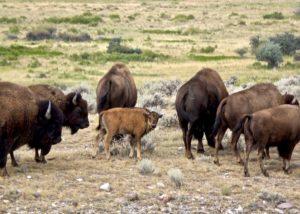
The first bison for the Wind River Reservation’s Buffalo Initiative came to Wyoming in 2016. Currently, the herd numbers around 220, with both the Eastern Shoshone and Northern Arapaho herds growing stronger in numbers.