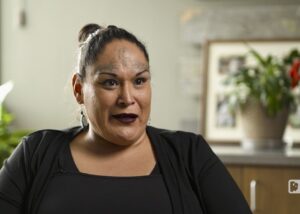
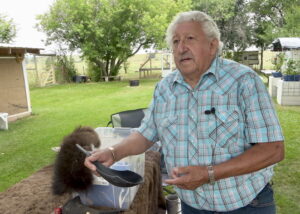
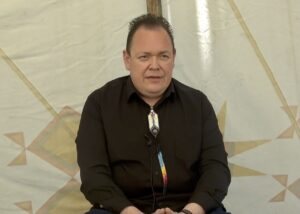
As Culture Director for the Fort Washakie School on Wyoming’s Wind River Reservation, an important part of Reba Teran’s work was teaching students the Shoshone language. Reba was a fluent speaker until the 6thgrade, when she had to concentrate on learning English at school. She explains how later, with the help of her older sister Beatrice Haukkas, colleague Manfred Guina, and a grant from the Luce Foundation, she began recording words with the goal of creating a dictionary specifically for the Eastern Shoshone.
The importance of language is summed up in the phrase “language is life”. Reba Teran explains that “language is alive – it’s a part of being a Native person”. To take away a person’s language she says, is to “take our spirit and life away from us”. Reba’s goal is to save both the Shoshone language and the spirit it expresses.
There are certain words and phrases in the Shoshone language for which there is no English equivalent. Reba Teran explains that Shoshone is a visual language, often expressing her people’s relationship with the natural world. The loon, for example, is called “brother of the lake” or “brother of the water”. Bigfoot is a “ghost creature” who has “been lost”. Her own mechanized wheelchair is “grey donkey”!
The Shoshone word for God expresses the tribe’s perception of themselves as “the people.”
Reba is working to finalize her dictionary and to find an appropriate place to host is so it may be available to all.
When a new, previously unknown dinosaur fossil was found near Dubois, Wyoming, close to the western edge of the Wind River Indian Reservation, those who discovered it decided to ask students at the Fort Washakie School to name it. The fossil was of a small, salamander-like dinosaur about 1 foot long that apparently lived in boroughs. Brainstorming with her students, Reba Teran, who teaches the Shoshone Language at the school, decided it should be called “Little People’s Pet.” Its small size – and the fact that it was discovered in an area known as one of the Little People’s territories – made the name a perfect fit.
Reba said naming the newly found fossil was an honor: “It actually made the New York Times!”
You may also be interested in:
Singing Shoshone Songs Shoyo drums and sings during a wide variety of activities – from commemorations at funerals…
The Battle of Greasy Grass Tanya Plain Feather Gardner describes how unprepared Custer and his men were for the conditions…
Bear River Massacre Bear River Massacre on January 29, 1863, was the result of a significant period of…
The Four Hills of Life The four hills of life - the baby, adolescent, adult, and elder stages, are all…
Buffalo - Many Uses Buffalo trunks are popular teaching tools, illustrating the strong connections of buffalo to Plains tribes