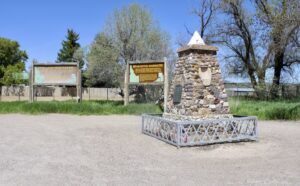
The high plains country of eastern Colorado is a rugged landscape – dry, with treeless hills, sand, cactus, and wind. Above the Arkansas River, on what was then the northern edge of the Upper Arkansas Reservation, on a bend of the Big Sandy lies the place now known as Sand Creek. It was here, at dawn on November 29, 1864, that one thousand US volunteer troops under the command of Colonel John M. Chivington attacked a peaceful and unsuspecting village of Cheyenne and Arapaho Indians. By the time it was over at least 230 people, mostly unarmed women, children, and the elderly, were massacred.
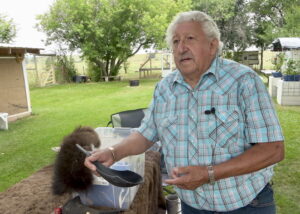
Northern Arapaho Gail Ridgely, of the Wind River Reservation, has been studying the history of this slaughter and its aftermath for over 40 years. In 1995, he worked with Dr. David Halaas, a curator for History Colorado, on an exhibition of this event. The display was part of the Sand Creek Project, a central goal of which was to create a Sand Creek Massacre Memorial. In 1998, legislation created the Sand Creek Massacre National Historic Site. Managed by the US National Park Service, this 4000-acre site commemorates this 1864 tragedy.
The first Sand Creek Massacre Spiritual Healing Run was held in 1999. Now an annual event, it memorializes and honors those killed. The run can also help heal historical trauma. The race starts near Eads, Colorado at the Sand Creek Massacre site. Runners are prepped with song and face paint to protect them along their journey as they travel to Denver, Colorado along the Sand Creek Massacre Trail. The 2025 run was held on October 23-26. It takes four days and ends at the Denver State Capital building. For more information about the Sand Creek Massacre Healing Run visit: https://www.sandcreekmassacrefoundation.org/
This is the sung at the beginning of the run.
Any time a milestone is crossed or a battle won, the Victory Song is sung. Essentially a war cry to the ancestors, it lets them know that there was a victory. The following is the Victory Song sung at the end of the Healing Run at the Denver State Capital Building.
The celebration of the Healing Run ends with the Welcome Home Song and the Chiefs’ Song. These songs are sung when warriors return home from battle and to honor the leaders of the tribe.
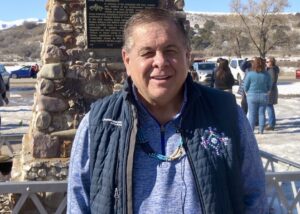
A location has been designated for a statue to honor those killed in the Sand Creek massacre; it is scheduled to be unveiled at the Denver State Capitol building in 2026. Otto Braided Hair of the Northern Cheyenne describes the time and effort needed to make the unveiling of this statue a reality.
You may also be interested in:
Bear River Massacre Bear River Massacre on January 29, 1863, was the result of a significant period of…
Buffalo - Many Uses Buffalo trunks are popular teaching tools, illustrating the strong connections of buffalo to Plains tribes
The Four Hills of Life The four hills of life - the baby, adolescent, adult, and elder stages, are all…
Feathers of a Chief "If you want to be a chief" his grandmother taught him, "you must lead a…
Unlost Connection Big Wind of the Northern Arapaho reminds us that his people have never lost their…
Pursuer An old woman known as The Pursuer is so persuasive that the council turns down…